
(Aug. 2014) Dramatic landscapes from the 19th century Hudson River School art movement were celebrated on Forever Stamps. The images personify the natural beauty of New York state and the Grand Canyon. The Hudson River School Forever Stamps, available nationwide in booklets of 20, were dedicated at the American Philatelic Society Stamp Show.
“Poet John Keats could have been writing about the landscapes painted by these four men when he said, ‘A thing of beauty is a joy forever,’” said U.S. Postal Service Vice President of Delivery and Post Office Operations Ed Phelan Jr. in dedicating the stamps. “These stamps are beautiful, and they are Forever Stamps. They will always be good to send a card or letter, no matter what the postage rate might be. They will last into the future, much like the paintings they honor.”
Joining Phelan in the dedication were American Philatelic Society (APS) Board of Vice Presidents Chairman Alexander Haimann; APS Executive Director Ken Martin; APS President Stephen Reinhard; U.S. Postal Service Citizens’ Stamp Advisory Committee member Katherine Tobin; U.S. Postal Service Director of Stamp Services and Corporate Licensing Susan McGowan; Connecticut District Manager David Mastroianni; and Hartford Postmaster Leeann Theriault.
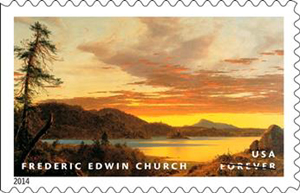
The stamps are 12th in the U.S. Postal Service’s American Treasures series. They feature paintings of Distant View of Niagara Falls by Thomas Cole (1801-1848); Summer Afternoon by Asher B. Durand (1796-1886); Sunsetby Frederic Edwin Church (1826-1900); and Grand Canyon by Thomas Moran (1837-1926). The designer and art director for these stamps was Derry Noyes of Washington, DC.
The Hudson River School Art Movement
During the 19th century, the artists of a young America searched for a new world view and found it in the very landscapes around them. Inspired by the stunning natural beauty of New York state and Arizona’s Grand Canyon, the loose-knit Hudson River School of painters flourished from the mid-1830s to the mid-1870s and gave America its first major school of art.
Frederic Edwin Church is represented by the 1856 painting Sunset, from the collection of the Munson-Williams-Proctor Arts Institute in Utica, NY. The painting is on loan to The Taft Museum in Cincinnati until Sept. 14, 2014.Inspired by one of many summer trips to the area around Mount Katahdin, ME, this idealized scene offers a fine example of Church’s ability to create dramatic and convincing depictions of sunlight.
The Hudson River School stamps are being issued as Forever stamps and will always be equal in value to the current First-Class Mail 1-ounce price.
 Frederic Edwin Church
Connecticut-born Frederic Edwin Church studied art with Cole in the Catskill Mountains in the mid-1840s, but soon developed his own unique style. Known for his incredible precision, Church dazzled viewers with paintings that were massive in size, meticulous in detail and conveyed a sense of the sublime.
In his New York City studio, Church combined sketches of various New York and New England locations into landscape paintings. In the 1850s, inspired by the travels of naturalist and explorer Alexander von Humboldt, he traveled in Colombia and Ecuador. The resulting paintings, which included a gigantic depiction of the Andes, secured his reputation as one of the greatest landscape painters of his generation. A public exhibit of a Church painting was an event that drew thousands or even tens of thousands of viewers: In 1857, one famous 7-foot-wide painting so stunned the public that a New York newspaper was moved to declare: “It is a view of Niagara Falls which will cause all others ever painted to be forgotten.”
In search of new sights, Church sketched icebergs in the North Atlantic.
When the loss of his two children to diphtheria in 1865 sent the grief-stricken artist and his wife to Jamaica, he painted gorgeous scenes of vegetation under distinctive tropical light. Later travels followed, but in the 1870s, Church and his family took up permanent residence in the Hudson River Valley, where he built Olana, an estate with a magnificent view of the Catskills.
Around his new home, now a New York State Historic Site, Church designed a garden landscape that won acclaim as a work of art in its own right. “The hand of man generally improves a landscape,” he wrote. “The earth has been given to him, and his presence in Eden is natural; he gives life and spirit to the garden.”