
 Tara Aprill of Manlius has co-authored an article describing five new species of tapeworms in Folia Parasitologica, an open-access international journal that covers all branches of animal parasitology.
Nine SUNY Oneonta alumni (all former undergraduate biology majors) collaborated with Associate Professor of Biology Florian Reyda on the research over a period of six years and are co-authors on the publication.
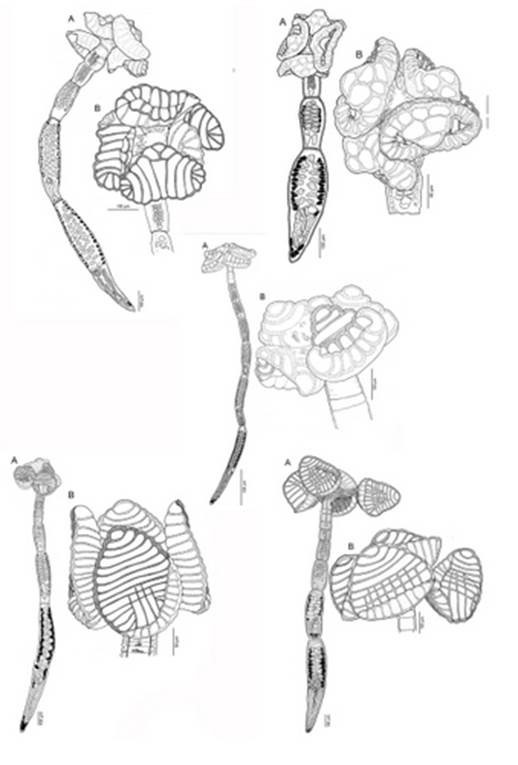
In the article, titled, “A new genus of rhinebothriidean cestodes from batted elasmobranchs, with the description of five new species and two new combinations,” Reyda and a colleague describe a new genus (group of species) of tapeworm from stingrays. “Stillabothrium” is named for the tear-dropped shape of one of its features, the bothridia of its scolex (attachment structures). A total of five new species of tapeworms are described, each by different combinations of student co-authors and Reyda. In each case, students picked the names of the new species and prepared scientific illustrations of them.
Aprill worked primarily on the Stillabothrium jeanfortiae species, from the stingray Himantura australis, which is found off the coast of Australia.
“One of the buzzwords in biology is biodiversity, or biological diversity,” said Reyda. “There are all these species and we have knowledge of a lot of them, but we’re always asking, ‘What species are still out there that humans have not yet discovered?’ The significance of this research is just simply filling in a major knowledge gap about the natural world. We’re the first people to look at those worms.”
Two of Reyda’s colleagues collected the parasite specimens in Malaysia, Indonesia, Australia and Senegal and turned them over to him and his students for analysis. All of the work was done at SUNY Oneonta’s Biological Field Station on Otsego Lake, where the students also learned how to collect fish parasite specimens to gain a better understanding of the project.
Aprill is in nursing school at Pomeroy College of Nursing at Crouse Hospital in Syracuse. She expects to graduate in May 2017.
“Working with fellow students who later became friends, and with Dr. Reyda, was the best part,” she said. “Everyone was very invested in helping one another learn and grow as researchers. Dr. Reyda was very passionate about this research, and that made it fun and interesting.”
This work was supported by a collaborative National Science Foundation grant on which Reyda was a participant, as well as by several student research grants funded by the SUNY Oneonta Foundation.