
Families of children with congenital heart disease visited the Capitol Monday, June 10 to successfully ask for passage of the Pulse Ox Bill. The children with capes were born with congenital heart defects. From left, Shannon, Jack and Maggie James of Clifton Park; bill sponsor Sen. William Larkin (R-Cornwall-on-Hudson); bill Sponsor Aileen Gunther, D-Forestburgh; Jacob, RJ and Kelsey Thomas of Syracuse; Dr. Harm Velvis, pediatric cardiologist, Albany; Aedan, Jennifer Corcoran and Tim Conway; Melissa and Colton Berlin of Gloversville.
(Albany, NY – June 11, 2013) Following Monday’s call from the Ame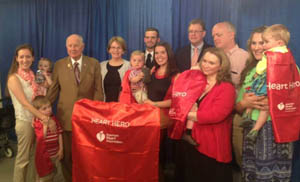 rican Heart Association’s littlest superheroes, the New York State Senate passed a bill to ensure all babies are screened for heart defects using a simple pulse ox test. The bill has already passed the Assembly.
Pulse oximetry, or pulse ox, is a simple, painless and inexpensive screening that can help detect heart defects before a baby leaves the hospital. Wider use could help identify more than 90 percent of heart defects.
“I’ll never forget the devastation we felt when our son, Jacob, was diagnosed with a rare congenital heart defect,” said Kelsey Thomas, of Syracuse. “That devastation quickly turned to an overwhelming sense of joy when our son survived open heart surgery at just eight days old and thrived in the days following. This test saved our little boy’s life and we know how lucky we are that it was performed on him when it was. If the test had not been performed, we would have lost him.”
Heart defects are the No. 1 defect in newborns, affecting approximately 1 in 100 babies. Thirteen other states call for babies to be screened with a pulse ox test, but New York doesn’t – yet. In New Jersey, just hours after the pulse ox law took effect, a newborn’s life was saved.
As the number one killer of infants with birth defects, congenital heart defects take a significant toll on families across the country. Pulse ox consists of sensors placed on a baby’s hand and foot to check blood oxygen levels. If their levels are too low, additional tests may be conducted that aid in detecting possibly life-threatening heart defects that might otherwise go undetected.
“Many CHD parents have lost their babies too soon because this test has not been a requirement in hospitals. Today, the Senate will make a difference in the lives of all future babies born with congenital heart disease. Thank you!” said Thomas.
“Pulse ox is a small test that can make a big difference,” said Julianne Hart, the American Heart Association’s government relations director for New York. “The test is quick painless and cheap. And more importantly, pulse ox is a lifesaver. We encourage the Governor to sign the bill immediately to protect our smallest hearts.”
In September 2011, the U.S. Health and Human Service Secretary adopted the Advisory Committee on Heritable Disorders in Newborns and Children’s recommendation to add pulse oximetry screening for critical congenital heart defects in newborns to the Uniform Screening Panel. It is now up to individual states to adopt this recommendation for their panels, determine an appropriate implementation strategy, and set a timeline for implementation.
The Pulse Oximetry Bill, A2316/S270, is sponsored by Assemblywoman Aileen Gunther, D-Forestburgh and state Sen. William Larkin, R-Cornwall-on-Hudson.